
Professional logo design: golden rules for a visually strong brand in 2026
Your logo is the first impression your company leaves on every prospect, partner and customer. It communicates in a fraction of a second what words take paragraphs to express. However, too many Moroccan companies still neglect this strategic dimension and entrust their visual identity to sloppy, generic or outdated designs.
And yet, 90 % of the judgments produced are based on colors and visual elements. Consequently, a professional logo design is not just an aesthetic exercise, it's a strategic investment that directly influences your brand perception, credibility and conversions. So, in this comprehensive guide, you'll discover all the golden rules for creating a professional logo design memorable, timeless and visually powerful in 2026.
Why is a professional logo design crucial for your business?
Visual identity, the cornerstone of customer confidence
First of all, we need to understand why the professional logo design goes far beyond mere aesthetics. Indeed, your logo is the focal point of your entire brand identity - it appears on your website, your social networks, your business cards, your packaging, your vehicles and every one of your marketing communications.
Consequently, a poorly designed logo sends an immediate negative signal: it suggests a lack of professionalism, insufficient attention to detail, or a company that doesn't invest in its own image. Conversely, a professional logo design A strong, consistent image inspires trust, builds credibility and makes it easier to remember your brand over the long term.
What's more, in 2026, graphic design is moving away from a decorative logic to a strategic, narrative and sustainable approach. Brands are no longer simply seeking to be modern, but to build strong visual identities, capable of expressing a vision, a personality and consistency across all points of contact.
A long-term business asset
In addition, a professional logo design success is a durable asset that increases in value over time. Indeed, the world's most powerful logos - Nike, Apple, Coca-Cola - are instantly recognized by billions of people, with no need to read the name. As a result, every euro invested in a professional logo design quality generates a return on investment that extends over years, even decades.
So don't give in to the temptation of a free logo generated in thirty seconds by an online tool. A professional logo needs to be thought out, designed and implemented by experts who understand your sector, your target market and your commercial ambitions.
The 7 golden rules of professional logo design
Rule 1: Simplicity is the key to memorization
First of all, the first rule of professional logo design is counter-intuitive for many entrepreneurs: less is often more. In fact, between 2015 and 2025, the use of logos with minimalist design increased by 45 %, and this trend continues into 2026. The world's most recognizable logos - Apple, Nike, X - are disconcertingly simple.
So resist the temptation to include too many elements in your logo. Indeed, in a world filled with visual noise, «less» can be a «more». Opting for one or two colors will allow your logo to stand out and work well everywhere, from your website to your packaging, without losing its impact. A simple logo is easier to remember, more versatile and more durable over time.
Rule 2: Consistency with brand values
In addition, a professional logo design must visually express what your company stands for. Indeed, each graphic choice - colors, typography, shapes - communicates a precise brand personality. So, before you embark on any graphic design, clearly define the core values your logo should embody.
For example, a technology company might rely on clean geometric shapes and cool colors to communicate innovation and precision. Conversely, a Moroccan artisanal brand will benefit from organic elements, handwritten typography and warm tones to express authenticity and local know-how.
Rule 3: Scalability on all media
What's more, your professional logo design must work perfectly at all sizes and on all media. Indeed, in 2026, a logo can appear just as well as a tiny 16-pixel application icon as on a large 6-meter-wide banner. Therefore, systematically test your logo in all configurations before approving it.
What's more, more than 50 % of companies are now adopting dynamic logos that have several variations adapted to each context: a simple icon for mobile applications, the full name for web media, and a combined version for social networks. Foreseeing these different versions right from the design stage is an essential part of every professional logo design modern.
Rule 4: Typography, your brand's signature identity
Moreover, typographic choice is one of the most decisive elements of a professional logo design. Indeed, typography has become a brand signature in its own right, with variable, expressive or extreme typefaces enhancing memorability.
So don't settle for a standard font available on all computers. Invest in custom typography or a premium font that matches your brand's personality exactly. In addition, make sure your logo's typography is perfectly legible at all sizes and on all backgrounds - light, dark, colored.
Rule 5: The psychology of colors to serve your message
What's more, your professional logo design are never neutral; they convey emotions and precise unconscious associations. In fact, 90 % of all judgments are based on color, making it a strategic lever of the first order. So choose your color palette with clear intent.
Blue communicates confidence and professionalism, which is why it is dominant in the financial and technology sectors. Red expresses energy, urgency and passion, and is favored by food brands and companies that want to stimulate action. Green evokes nature, health and sustainability, ideal for brands committed to environmental responsibility. Finally, black conveys elegance, luxury and sophistication, and is highly prized by premium brands.
Rule 6: Originality and competitive differentiation
In addition, a professional logo design must clearly distinguish you from your competitors. Indeed, if your logo resembles that of another company in your sector, you create confusion in the minds of your prospects and dilute your brand identity.
Therefore, make a thorough study of your main competitors' logos before designing your own. Identify the dominant visual codes in your sector, then deliberately seek to distinguish yourself on at least one or two key elements. In this way, your professional logo design becomes immediately identifiable as belonging to your brand and to no other.
Rule 7: Timelessness rather than passing fashion
Finally, the seventh golden rule of the professional logo design is perhaps the most difficult to respect: create a timeless logo rather than a trendy one. Graphic trends evolve every year, and a logo too firmly rooted in the aesthetic codes of its time risks looking dated in just a few years.
So take inspiration from current trends, but don't copy them blindly. In short, the best professional logo design is the one that remains relevant and recognizable for at least ten to fifteen years, requiring only minor adjustments rather than a complete overhaul.
Trends in professional logo design in 2026
Neo-minimalism: clarity and human warmth
In addition, the dominant trend in professional logo design in 2026 is neo-minimalism. Indeed, warm neo-minimalism retains the clean aesthetic of classic minimalism, but includes sober, inviting color palettes, with soft lines and subtle gradations. As a result, this style offers the best of both worlds: the legibility and versatility of minimalism, combined with the warmth and humanity that consumers seek in response to AI-generated content.
Adaptive and dynamic logos
What's more, in 2026, brand identity is no longer conceived as a fixed image, but as a living organism whose visual behavior - the way a logo breathes, reacts to hovering or deploys dynamically - becomes the main vector of recognition and emotion. As a result, adaptive logos, which adjust automatically according to context, platform or even user, represent the future of the professional logo design.
Authenticity and a return to the handmade
What's more, the public, massively exposed to creations generated by artificial intelligence, is developing a heightened sensitivity to authenticity, human creation and the graphic gesture. Experts are observing the emergence of a veritable “Not by AI” symbolic label. As a result, logos that incorporate handmade elements - hand-drawn strokes, handwritten typography, raw textures - offer powerful differentiation in a visual universe increasingly saturated with artificial content.
Mistakes to avoid when designing your logo
Using overly generic elements
However, there are a number of common mistakes that sabotage professional logo design yet well-intentioned. The first mistake is to use graphic elements that are too generic - light bulbs for innovation, gears for industry, globes for international. In fact, these symbols are so widely used that they no longer differentiate anyone.
Neglecting vector formats
Furthermore, a very common technical error is to create a logo only in raster format (JPEG, PNG) without having a vector version (SVG, AI, EPS). Indeed, without a vector file, your logo cannot be enlarged without losing quality, which creates major problems for large-format printing, signage and professional media.
Confusing personal popularity with brand needs
What's more, many entrepreneurs choose a logo that appeals to them personally, without considering whether it speaks to their target audience. Therefore, involve people who are representative of your target audience in the process of validating your logo. professional logo design, and base your decisions on objective feedback rather than personal preferences.
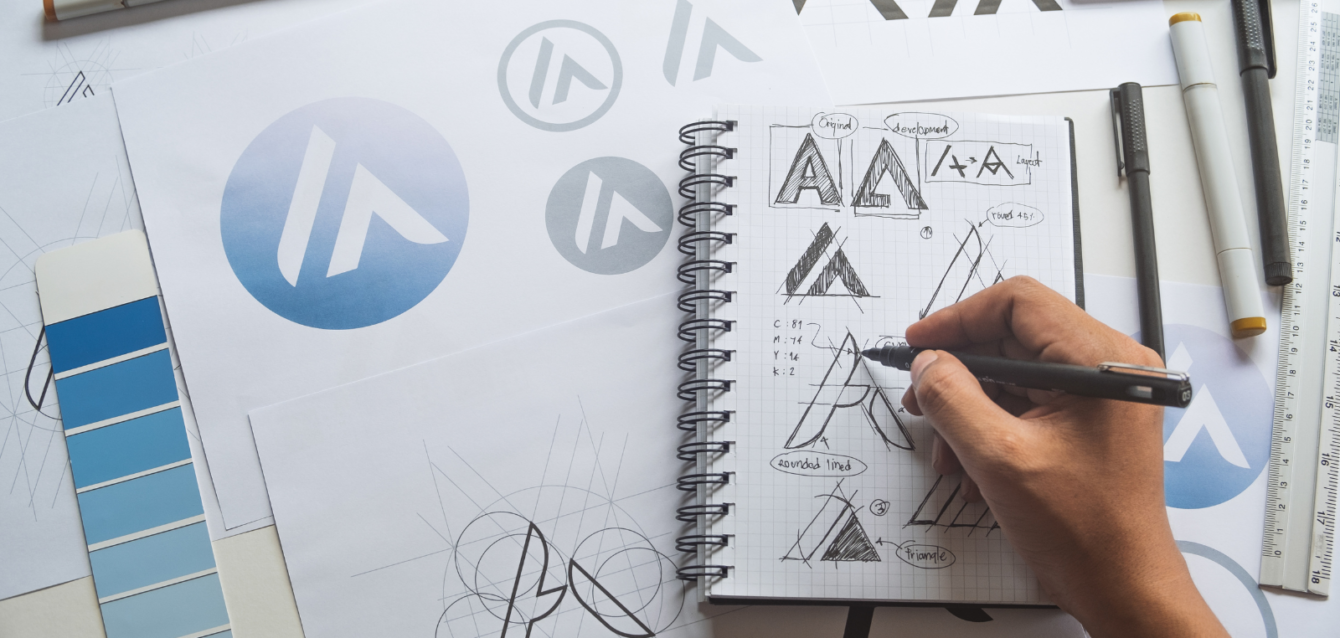
The process of creating a professional logo design
Key stages in a successful start-up
In short, the creation of a professional logo design follows a structured process that begins long before the first stroke of the stylus. First, the creative brief precisely defines the brand's values, target audience, competitors and visual references. Next, the research and exploration phase generates a number of very different creative avenues.
What's more, the presentation and iteration phase refines the best paths based on customer feedback. It is therefore essential to include at least two or three revision cycles in the process. Finally, delivery of the final files in all necessary formats - vector, raster, horizontal, vertical, black, white, color - concludes the process of creating professional logo design.
Conclusion: invest in a professional logo design that matches your ambitions
In short, a professional logo design is much more than just a graphic symbol, it's the visual foundation of your entire brand identity. In fact, it influences the first impression you make on your prospects, the trust you inspire in your customers, and the consistency of all your marketing communications.
So don't leave this strategic mission to chance or to generic solutions. Invest in a professional logo design designed by experts who understand your market, your target and your growth objectives. That way, your logo becomes a lasting asset that works for you at every point of contact with your audience.
Our team of designers at Astral Digital creates customized visual identities, rooted in in-depth strategic thinking about your brand. Discover our Design & Branding and our comprehensive approach to website creation to deploy your visual identity on all your digital media. Contact Astral Digital for a free diagnosis of your brand image.
About Astral Digital
Astral Digital is your leading digital marketing and branding agency in Rabat, Morocco. Our creative team supports Moroccan companies in designing their professional logo design, We take care of their entire graphic identity and brand identity from A to Z. We combine strategic vision and creative expertise for memorable, coherent and differentiating visual identities. Contact Astral Digital to create or redesign your logo today.

 French
  English